Summer 2026 Capstone Projects
A Comparative Study of StarDist and Cellpose for 0--2 mm Oyster Seed Detection and Counting
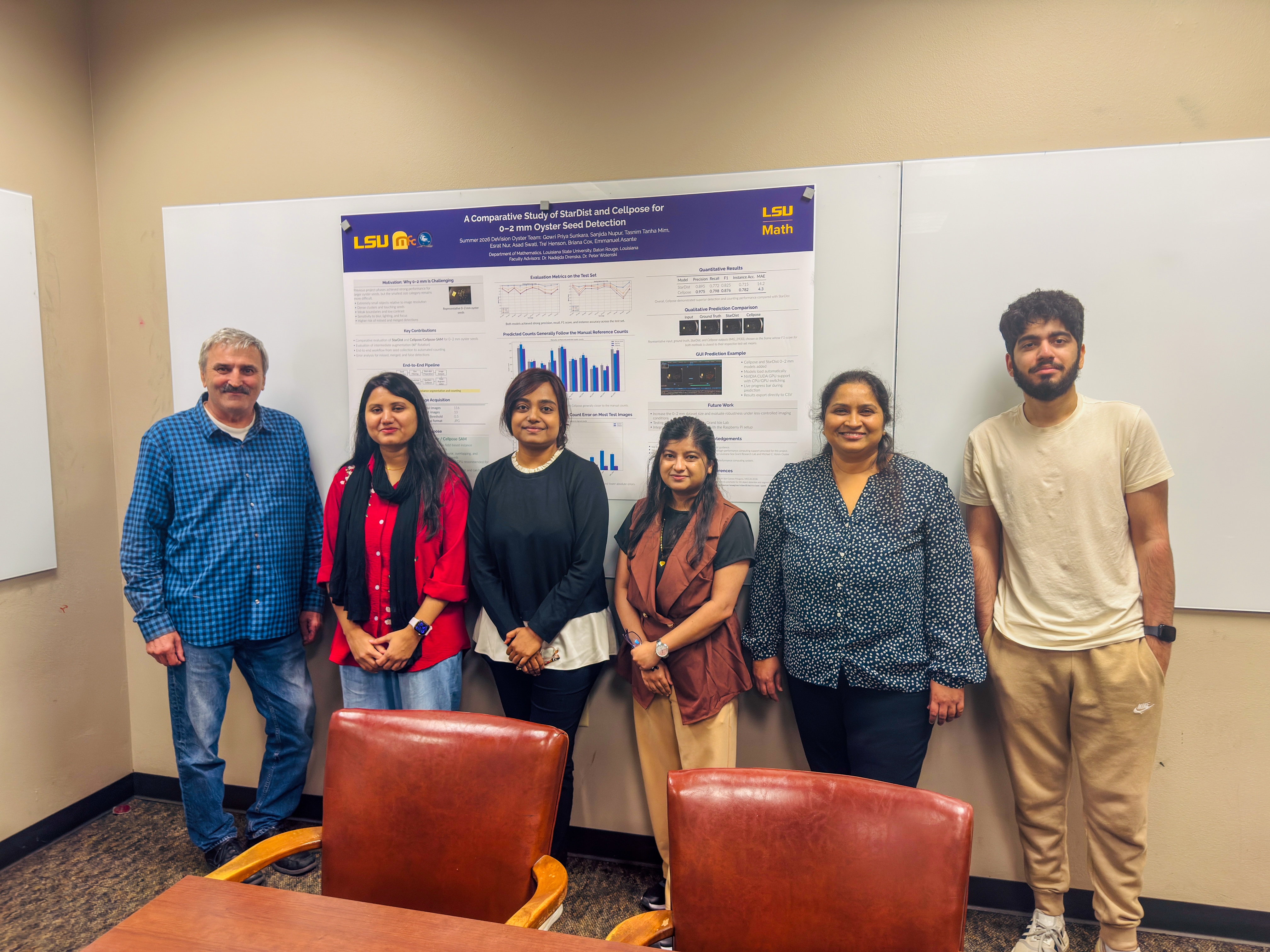
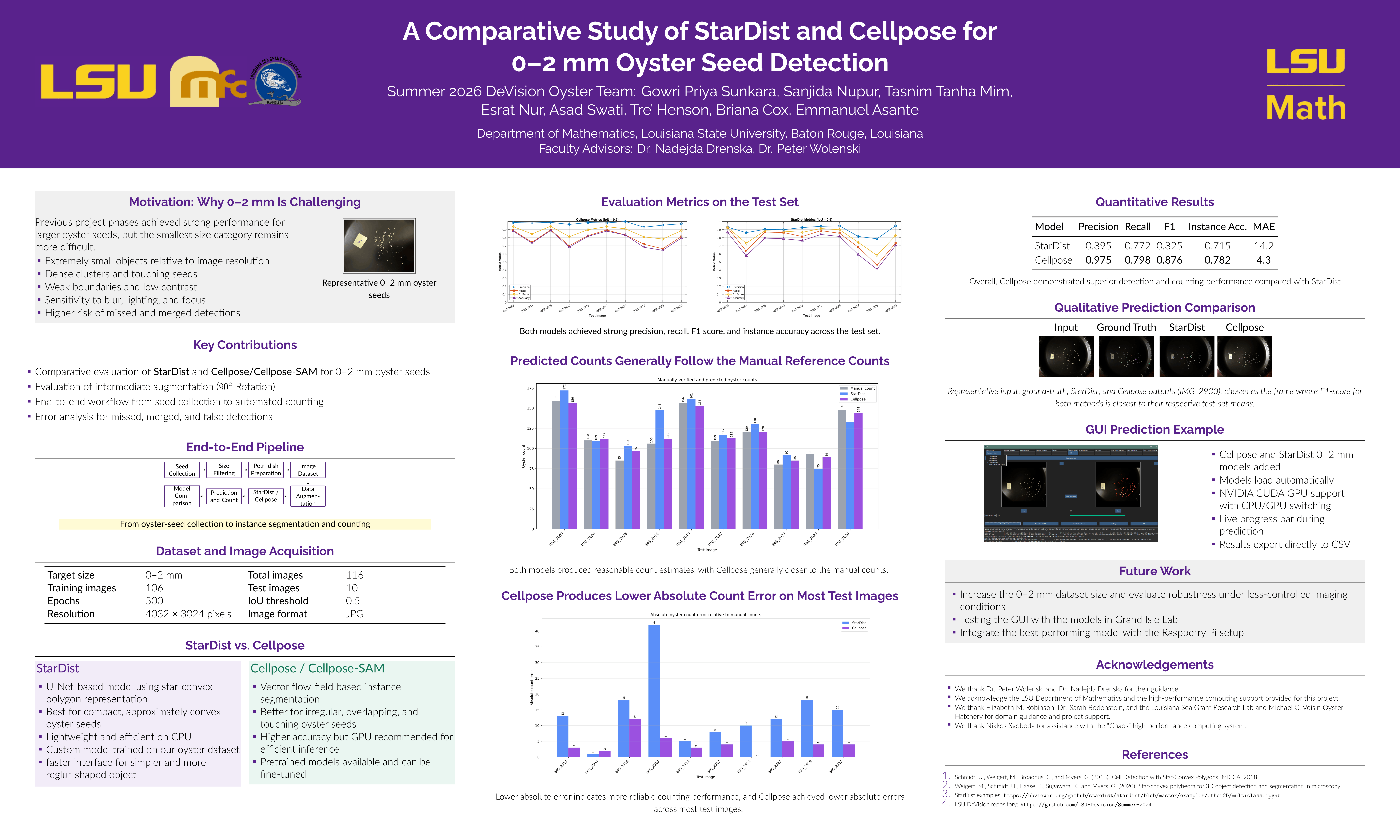
The Oyster Project focuses on developing an automated method for detecting and counting oyster seeds using deep learning. During Summer 2026, the team concentrated on the challenging 0–2 mm oyster-seed category, where the small size and close spacing of individual seeds make manual and automated counting difficult. Two deep-learning instance-segmentation methods, StarDist and Cellpose, were evaluated using a dataset of 116 oyster-seed images, with 106 images used for model development and 10 held out for final testing. Both models successfully detected and counted 0–2 mm oyster seeds, with Cellpose achieving the stronger overall performance, including 97.5% precision, an F1 score of 87.6%, and a mean absolute counting error of 4.3 oysters per image. The oyster-counting graphical user interface was also updated to support the new models, GPU acceleration, prediction progress, and CSV export. Downloadable files related to the project are attached below.
Click here to watch the video presentation.
Click here to access the LSF 0-2mm oyster project GitHub repository.
Predicting Biological Age Based on Bio-measurements
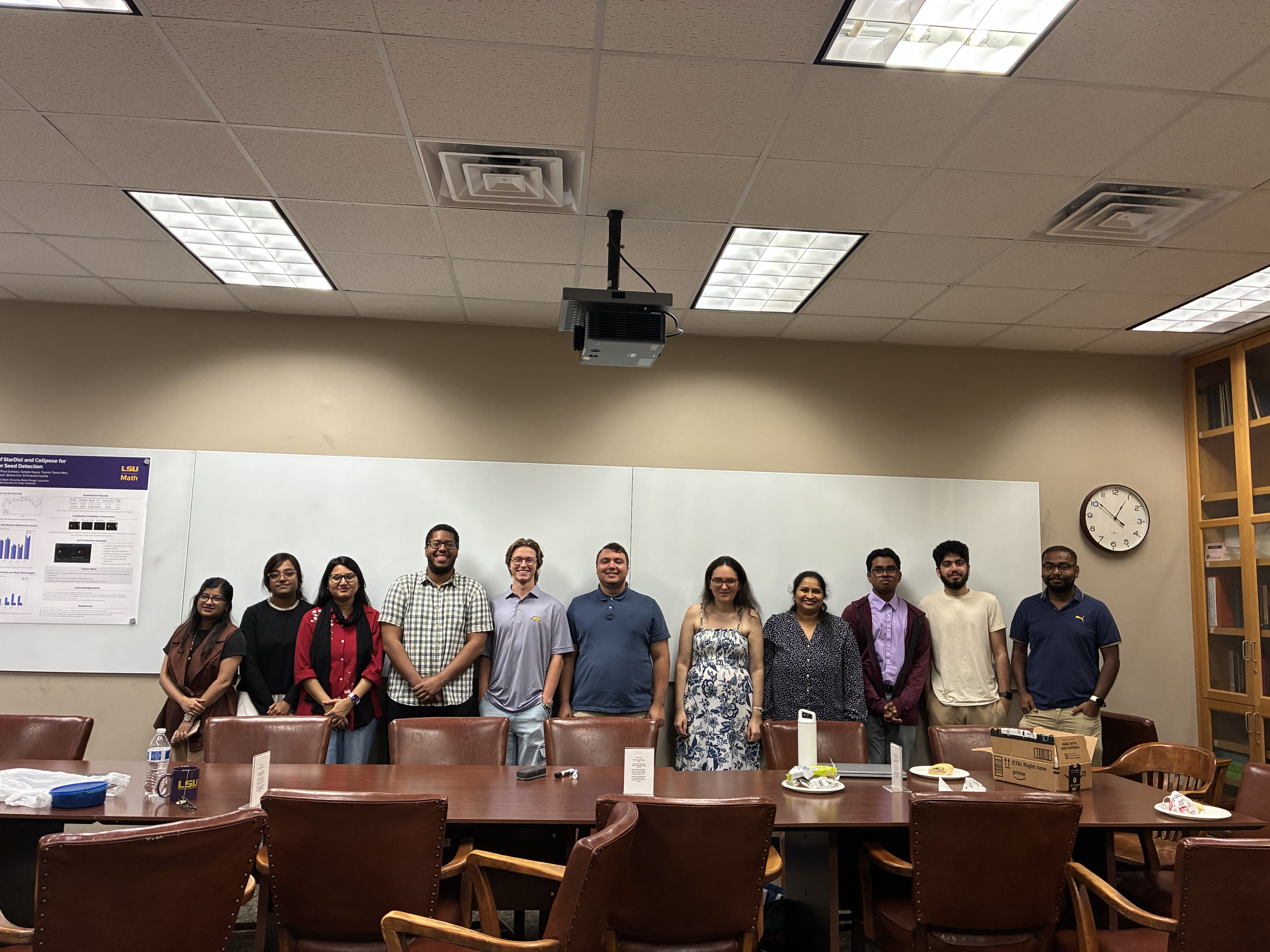
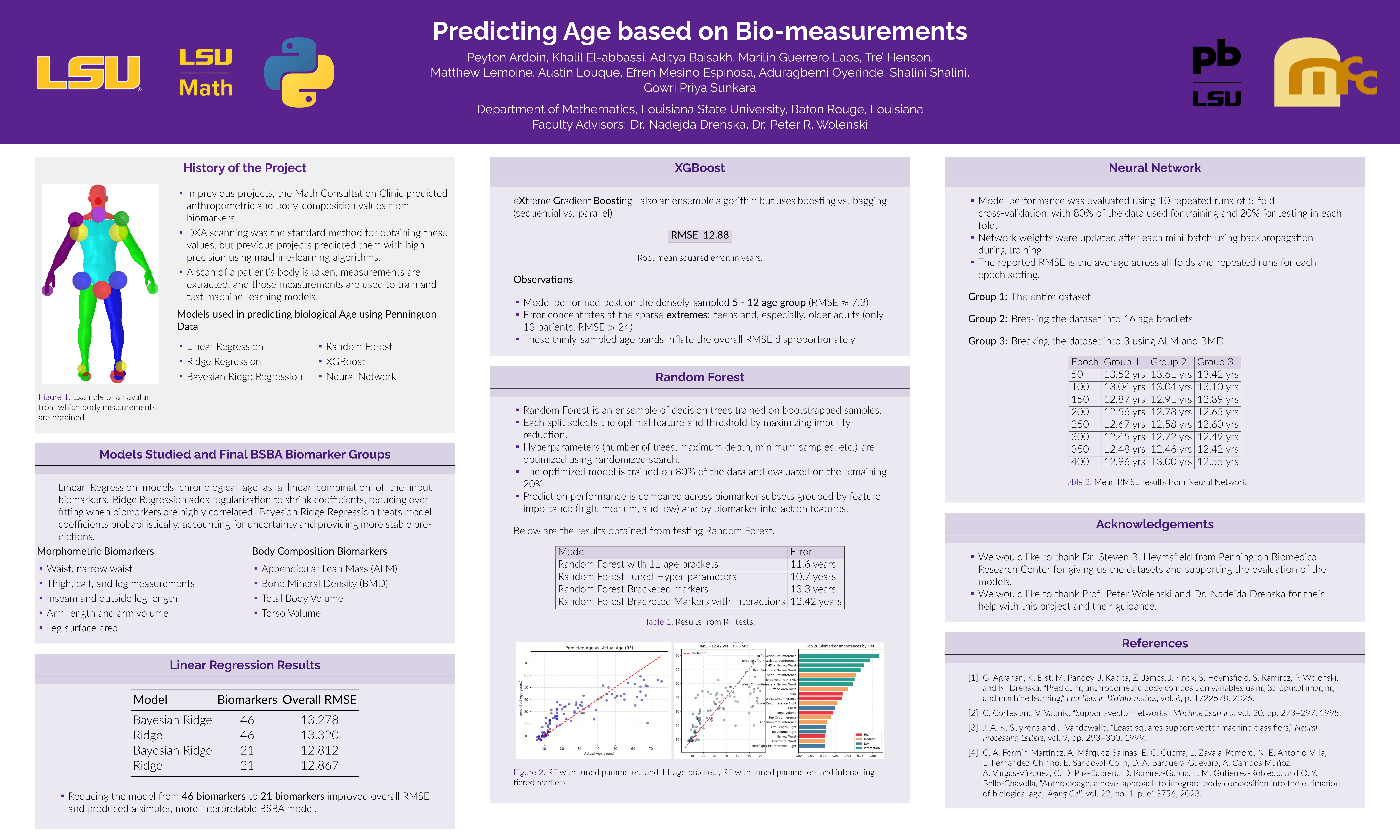
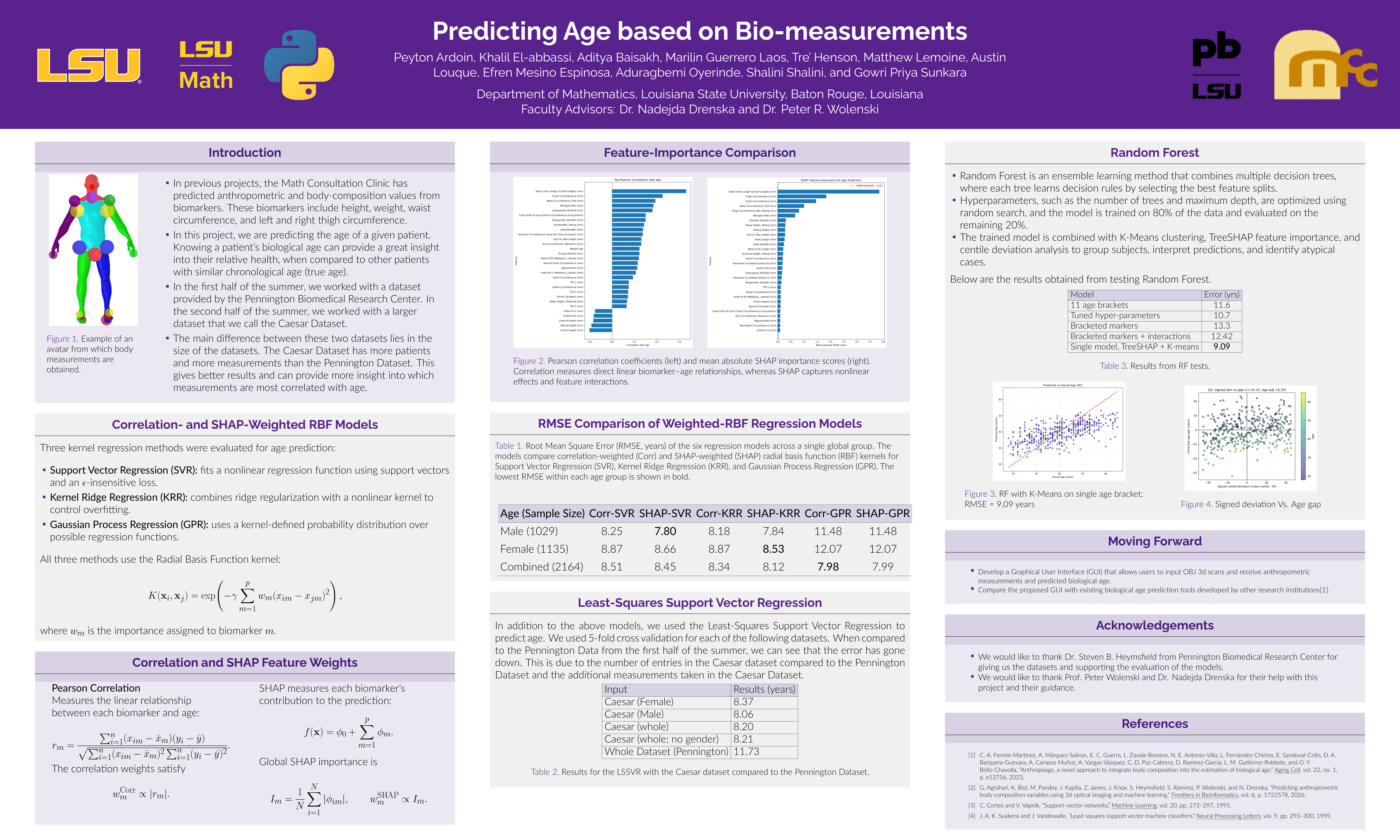
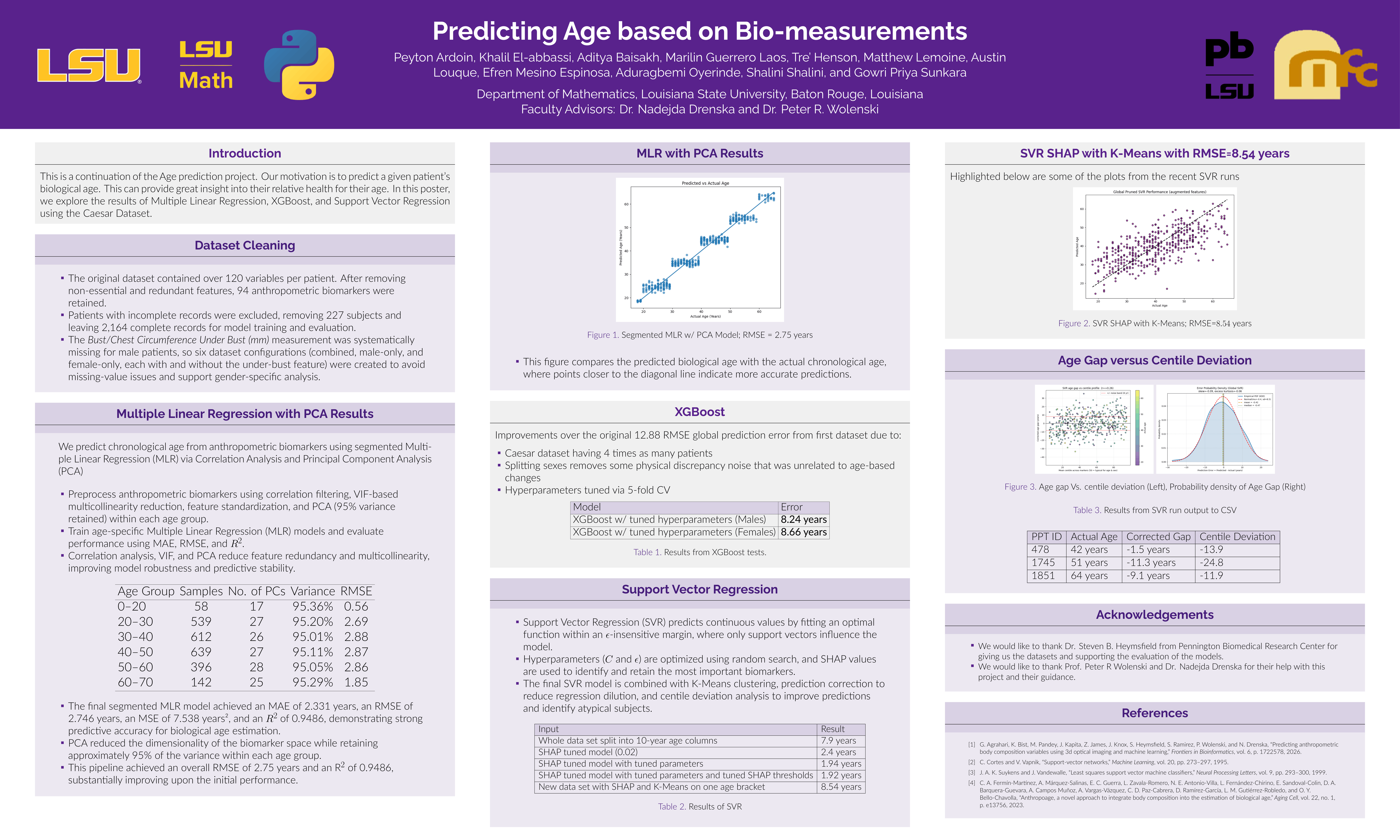
The project's goal is to investigate whether anthropometric measurements obtained from body scans can be used to predict a person's age. The study used the Pennington and CAESAR datasets and evaluated several statistical and machine-learning approaches, including linear regression, Random Forest, XGBoost, Support Vector Regression, Kernel Ridge Regression, and Gaussian Process Regression. Feature-selection and dimensionality-reduction methods such as correlation analysis, SHAP, Principal Component Analysis (PCA), and clustering were also investigated to identify important biomarkers associated with age. The CAESAR dataset contained 2,164 participants and 94 biomarkers after preprocessing. The results highlight the potential of anthropometric biomarkers and machine-learning methods for estimating age from measurable body characteristics. The image above shows the members of all the project teams. Downloadable files related to the project are attached below.
Click here to watch the video presentation.
Click here to access the Biological Age GitHub repository.
Predicting a Pitcher's Success with Stuff+
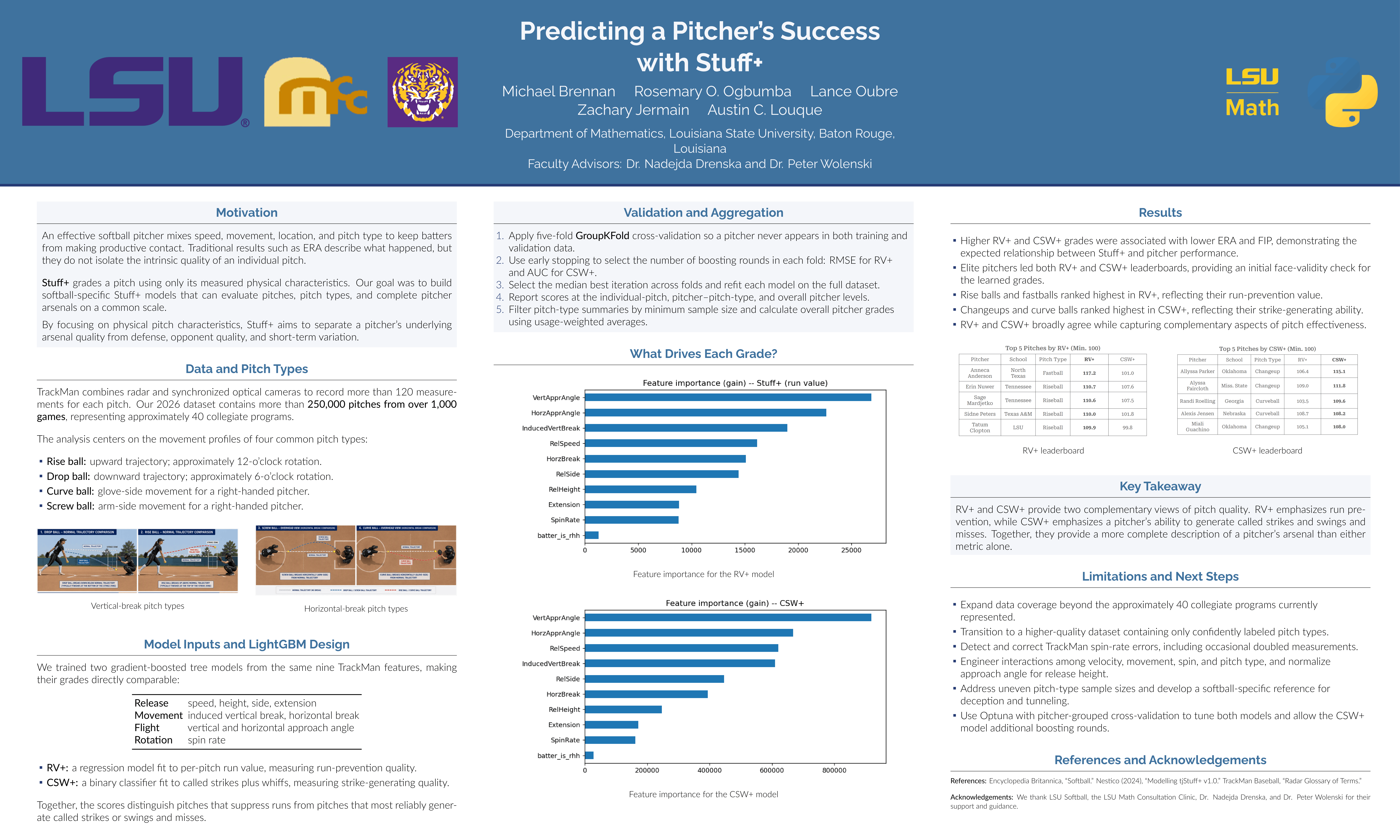
The Softball Project focuses on using machine learning and TrackMan data to evaluate pitch quality and better understand a pitcher's success. The dataset contains detailed measurements for more than 250,000 pitches from over 1,000 collegiate softball games. Two LightGBM models were developed using pitch characteristics such as release speed, spin rate, release position, vertical and horizontal break, and approach angle. The models produce two complementary measures, RV+ and CSW+, representing run-prevention and strike-generating ability. Results showed that rise balls and fastballs ranked highly for run prevention, while changeups and curveballs performed strongly for generating called strikes and swings-and-misses. The project provides a data-driven approach for comparing pitches and evaluating pitcher performance. Downloadable files related to the project are attached below.
Click here to watch the video presentation.
Pennington MATLAB to Python
The Pennington MATLAB to Python Project focuses on converting and organizing existing body-scanning and anthropometric analysis tools into a unified Python framework. The project processes 3D body-scan models to extract anthropometric measurements using slice-based and segmentation-based methods, while also incorporating existing machine-learning, PCA, and visualization tools. Moving the workflow from MATLAB to Python makes the system easier to share, test, automate, and extend without requiring MATLAB licensing. The unified framework provides a foundation for future development in body measurement extraction, machine learning, and automated analysis of 3D body scans. Project materials and downloadable files are available below.
Click here to watch the video presentation.
Click here to access the Pennington-Matlab-Python GitHub repository.
| Attachment | Size |
|---|---|
 Oyster_team.jpg Oyster_team.jpg | 3.18 MB |
| All_teams.jpg | 3.76 MB |
 LSG_cellpose_poster.pdf LSG_cellpose_poster.pdf | 3.67 MB |
| LSG_cellpose_presentation.pdf | 245.57 KB |
| LSG_cellpose_report.pdf | 192.95 KB |
| Bioage_poster1.pdf | 393.29 KB |
| Bioage_poster2.pdf | 1.25 MB |
| Bioage_poster3.pdf | 478.25 KB |
| BioAge_presentation.pdf | 1.84 MB |
| Bioage_report.pdf | 1.72 MB |
| LSU_softball_poster.pdf | 7.11 MB |
| LSU_softball_presentation.pdf | 7.2 MB |
| Bioage_poster1-1.png | 1.18 MB |
| Bioage_poster2-1.png | 1.32 MB |
| Bioage_poster3-1.png | 1.24 MB |
| LSG_cellpose_poster-1.png | 1.24 MB |
| LSU_softball_poster-1.png | 1.5 MB |