Fall 2023 Capstone Projects

Aquaponic Deep Water Systems
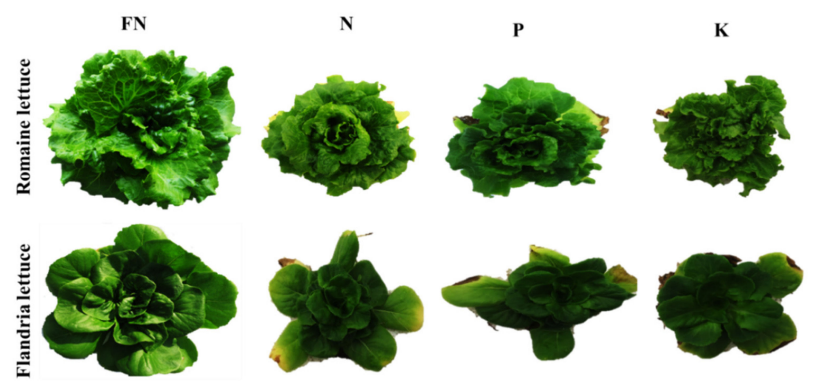
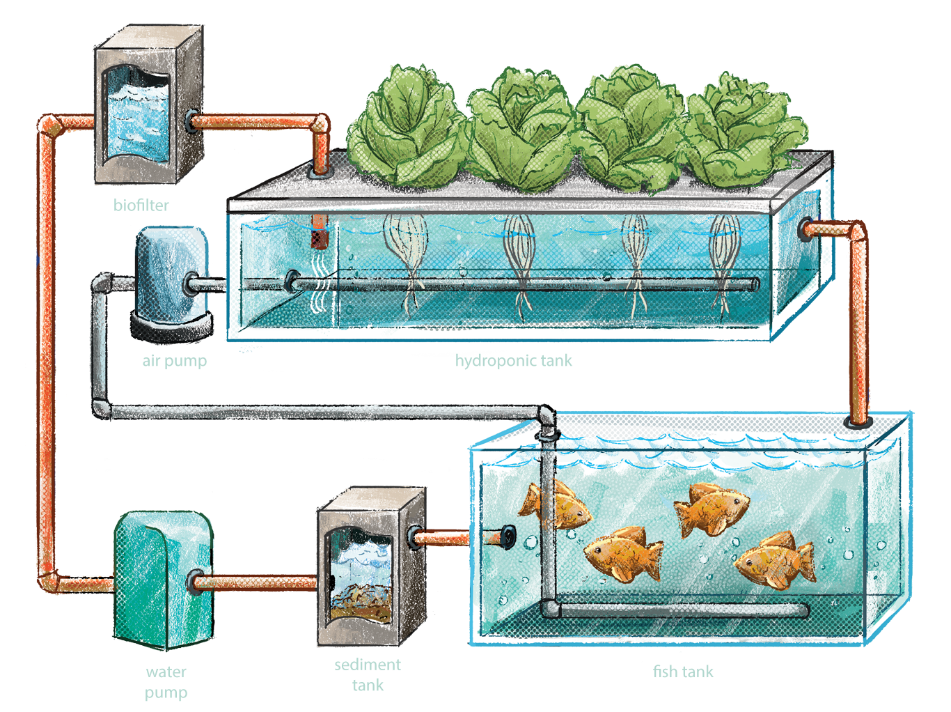
This semester, our team worked on an image classification problem involving plants grown aquaponically. Our collaborators at Pure Reason AI are currently working on growing plants in a deep-water culture system here at LSU. This system works by transferring nutrients produced by fish to the plants that are grown using only water. This method takes away the need for soil and produces plants that only need water and nutrients to grow. Our goal this semester was to classify images of lettuce plants into one of four categories: fully nutritious (FN), potassium deficient (K), nitrogen deficient (N), or phosphorus deficient (P). We accomplished this goal by training two neural networks to detect the deficiencies in the images and classify them accordingly. This goal was met by researching similar projects, utilizing Python to create the neural networks, and training them to classify images on a dataset provided by our collaborators. Some future works for this project include researching more methods for image classification and developing our neural networks to handle issues such as light, shadows, and noise. Our collaborators are interested in classifying images based on light and possibly applying Spectral Theory to detect the deficiencies. We accomplished our goal of classifying images based on nutrient deficiencies, but more work is needed to help create a user-friendly system that can be used by anyone growing plants aquaponically.
References
Aquaponic Systems
- “Food Production and Water Conservation in a Recirculating Aquaponic System in Saudi Arabia at Different Ratios of Fish Feed to Plants.” Accessed December 10, 2023. https://onlinelibrary.wiley.com/doi/10.1111/j.1749-7345.2008.00181.x.
- “Recirculating Aquaculture Tank Production Systems: Aquaponics—Integrating Fish and Plant Culture - Oklahoma State University,” March 1, 2017. https://extension.okstate.edu/fact-sheets/recirculating-aquaculture-tank-production-systems-aquaponics-integrating-fish-and-plant-culture.html.
Deep Water Culture Systems
- Garner, John. “Deep Water Culture (DWC) Systems: A Complete Guide for Hobbyists.” Ponics Life (blog), July 17, 2023. https://ponicslife.com/deep-water-culture-dwc-systems-a-complete-guide-for-hobbyists/.
- Swarup Sahoo, Rudra, Chandan Kumar Tripathy, Umakanta Samantasinghar, and Priyabrata Biswal. “Implementation of an Indoor Deep Water Culture Farming System Using IoT.” In 2022 IEEE 2nd International Symposium on Sustainable Energy, Signal Processing and Cyber Security (iSSSC), 1–5, 2022. https://doi.org/10.1109/iSSSC56467.2022.10051358.
Economic Data
- AcreTrader, I. (n.d.). Average farmland prices in Louisiana (LA) | AcreTrader. AcreTrader. Retrieved December 20, 2023, from https://acretrader.com/resources/louisiana-farmland-prices
- EnergySage. “Electricity Cost in Baton Rouge, LA: 2023 Electric Rates.” Accessed December 20, 2023. https://www.energysage.com/local-data/electricity-cost/la/east-baton-rouge-county/baton-rouge/.
- Freight Farms. “Pricing.” Accessed December 20, 2023. https://www.freightfarms.com/pricing [archive.org].
- Washington State University Extension. (2012). 2011 Cost Estimates of Producting Fresh Market Field-Grown Head Lettuce in Western Washington [Fact sheet]. U.S. Department of Agriculture. https://s3.wp.wsu.edu/uploads/sites/2073/2014/09/2011-Costs-Estimates-of-Producing-Fresh-Market-Field-Grown-Head-Lettuce-in-Western-Washington.pdf
Economic Analysis
- Goddek, Simon, Boris Delaide, Utra Mankasingh, Kristin Vala Ragnarsdottir, Haissam Jijakli, and Ragnheidur Thorarinsdottir. “Challenges of Sustainable and Commercial Aquaponics.” Sustainability 7, no. 4 (April 2015): 4199–4224. https://doi.org/10.3390/su7044199.
- Tourte, Laura, Richard Smith, Michael Cahn, Kirsten Pearsons, and Yu-Chen Wang. “Sample Costs to Produce and Harvest Film Wrapped Iceberg Letuce: Central Coast Region,” 2023. University of California, Davis. https://coststudyfiles.ucdavis.edu/uploads/pub/2023/08/04/2023-iceberglettuce-full-final.pdf
Nutrient Deficiency Detection
- Eshkabilov, Sulaymon, Arim Lee, Xin Sun, Chiwon W. Lee, and Halis Simsek. “Hyperspectral Imaging Techniques for Rapid Detection of Nutrient Content of Hydroponically Grown Lettuce Cultivars.” Computers and Electronics in Agriculture 181 (February 1, 2021): 105968. https://doi.org/10.1016/j.compag.2020.105968.
- Mani, Balamurugan, and Jayalakshmi Shanmugam. “Estimating Plant Macronutrients Using VNIR Spectroradiometry.” Polish Journal of Environmental Studies 28, no. 3 (February 18, 2019): 1831–37. https://doi.org/10.15244/pjoes/89585.
- Pacumbaba, R. O., and C. A. Beyl. “Changes in Hyperspectral Reflectance Signatures of Lettuce Leaves in Response to Macronutrient Deficiencies.” Advances in Space Research 48, no. 1 (July 1, 2011): 32–42. https://doi.org/10.1016/j.asr.2011.02.020.
- Petrazzini, Lauro L., Guilherme A. Souza, Cléber L. Rodas, Eduardo B. Emrich, Janice G. Carvalho, and Rovilson J. Souza. “Nutritional Deficiency in Crisphead Lettuce Grown in Hydroponics.” Horticultura Brasileira 32 (September 2014): 310–13. https://doi.org/10.1590/S0102-05362014000300012.
Using Convolutional Neural Networks for Nutrient Deficiency Detection
- Gui, Z; Bora, S. “Exploiting Pre-Trained Convolutional Neural Networks for the Detection of Nutrient Deficiencies in Hydroponic Basil”, Sensors Volume 23, Issue no. 12 (June 2023): 5407. https://doi.org/10.3390/s23125407
- Taha, M; Abdalla, A; ElMasry, G; Gouda, M; Zhou, L; Zhao, N; Liang, N; Ziu, Z; Hassanein, A; Al-Rejaie, S; He, Y; Qiu, Z. “Using Deep Convolutional Neural Network for Image-Based Diagnosis of Nutrient Deficiencies in Plants Grown in Aquaponics” Chemosensors 10, no. 2 (January 2022): 45. https://doi.org/10.3390/chemosensors10020045
- Yudha Pratama, Ichsan, Abdi Wahab, and Mudrik Alaydrus. “Deep Learning for Assessing Unhealthy Lettuce Hydroponic Using Convolutional Neural Network Based on Faster R-CNN with Inception V2.” In 2020 Fifth International Conference on Informatics and Computing (ICIC), 1–6, 2020. https://doi.org/10.1109/ICIC50835.2020.9288554.
Deep Learning Approach for Frog Egg Quantification
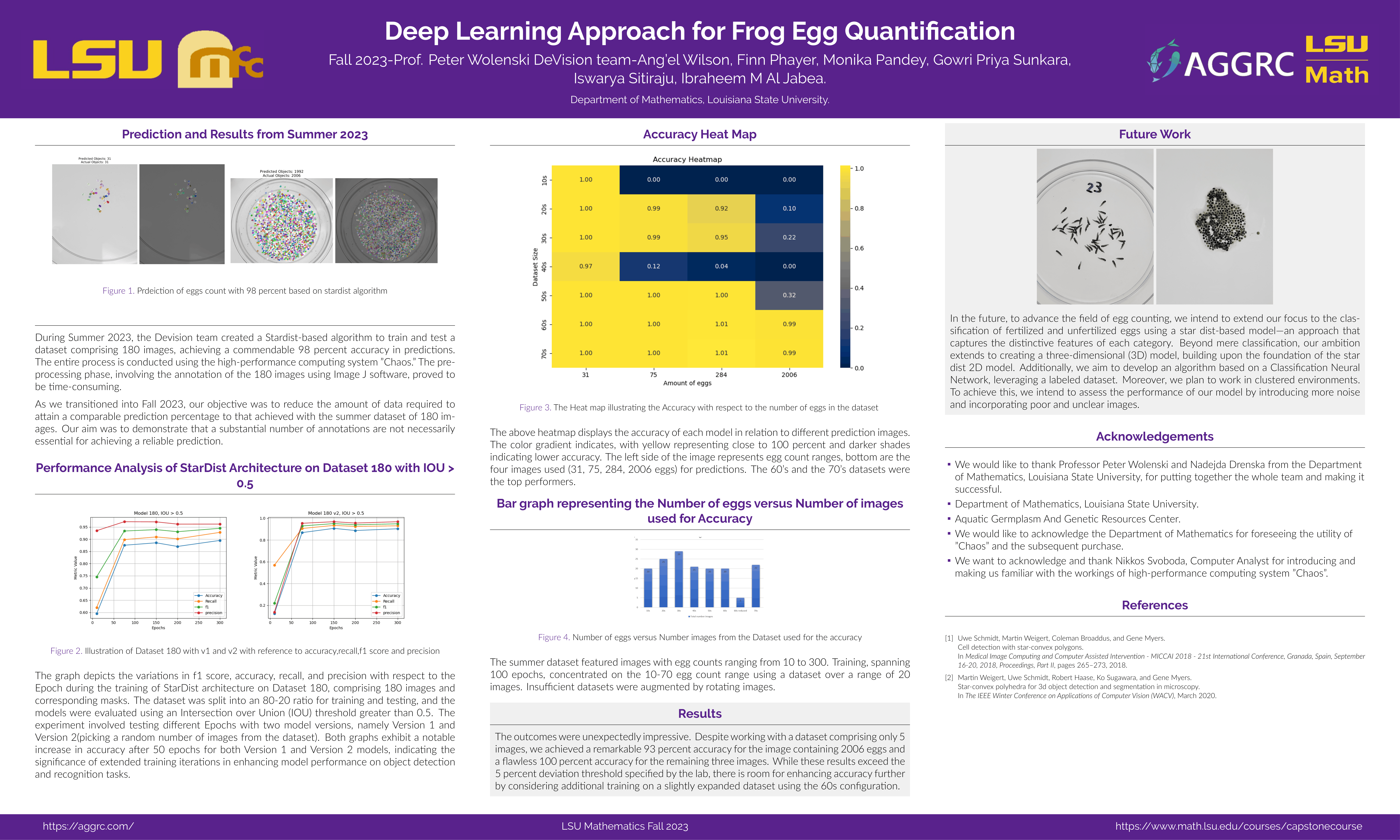
The Frog Egg Quantification Project focuses on using deep learning to automatically detect and count frog eggs from images. Building on the Summer 2023 StarDist model trained with 180 annotated images, the Fall 2023 team investigated whether similar counting accuracy could be achieved using substantially smaller training datasets. Different dataset sizes and training configurations were evaluated using accuracy, precision, recall, and F1 score. The experiments showed that strong predictions could be obtained with fewer annotated images, including 93% accuracy on an image containing 2,006 eggs and 100% accuracy on three additional test images using a model trained with only five images. These results demonstrate the potential to reduce the time required for image annotation while maintaining reliable automated frog-egg counting.
Appendicular Lean Mass: Insights through Regression Analysis
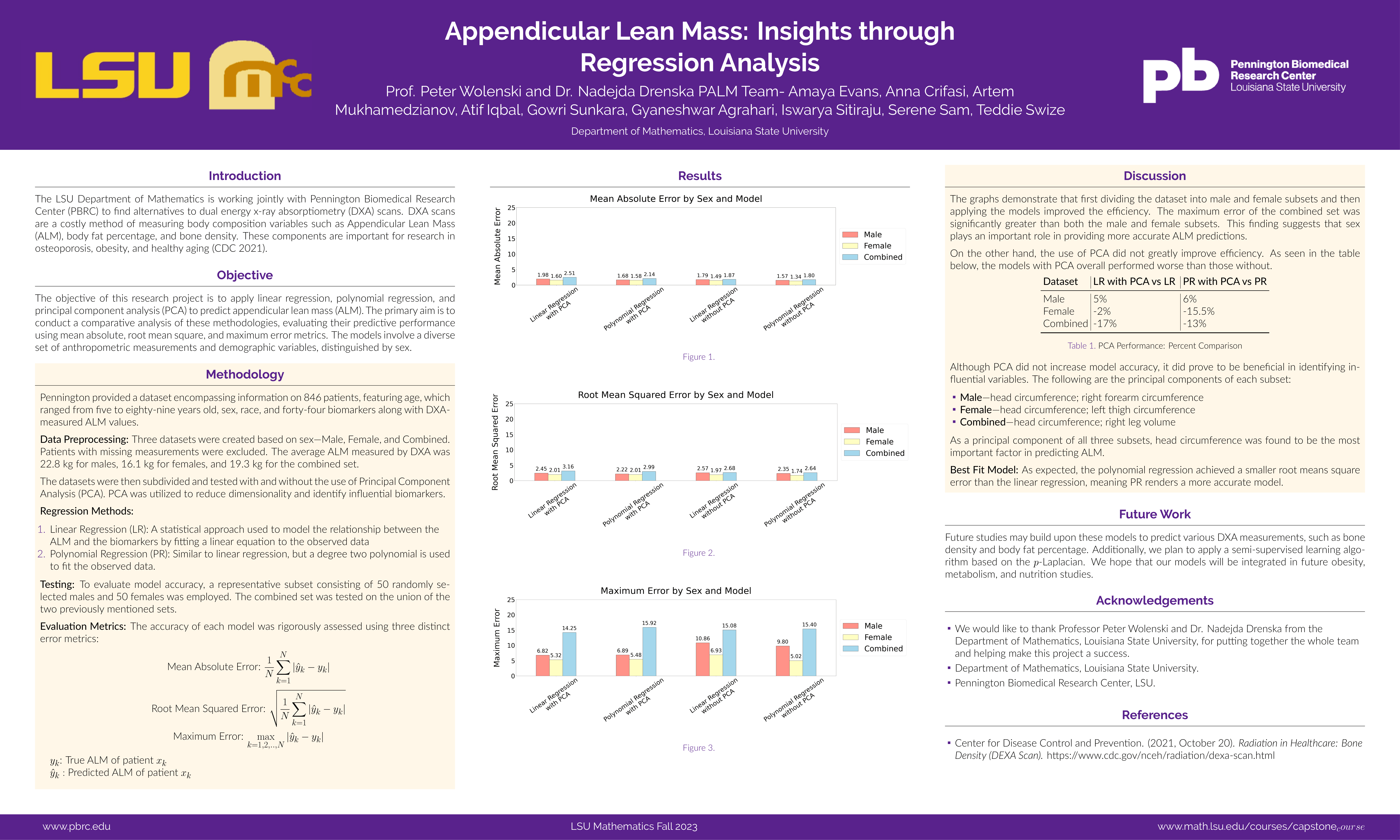
The Appendicular Lean Mass Project focuses on using anthropometric measurements and regression methods to predict Appendicular Lean Mass (ALM) as a potential alternative to DXA-based measurements. The study used data from 846 participants and compared Linear Regression and Polynomial Regression with and without Principal Component Analysis (PCA). The data were also analyzed separately for male, female, and combined populations to investigate the effect of sex on prediction accuracy. Results showed that sex-specific models improved prediction performance and that Polynomial Regression achieved lower prediction error than Linear Regression. PCA was also used to identify influential anthropometric measurements associated with ALM. The project provides a foundation for extending these approaches to other body-composition measurements such as bone density and body fat percentage.
Predicting Equity Markets using Monte Carlo Markov Chain Models & Probabilistic Neural Networks
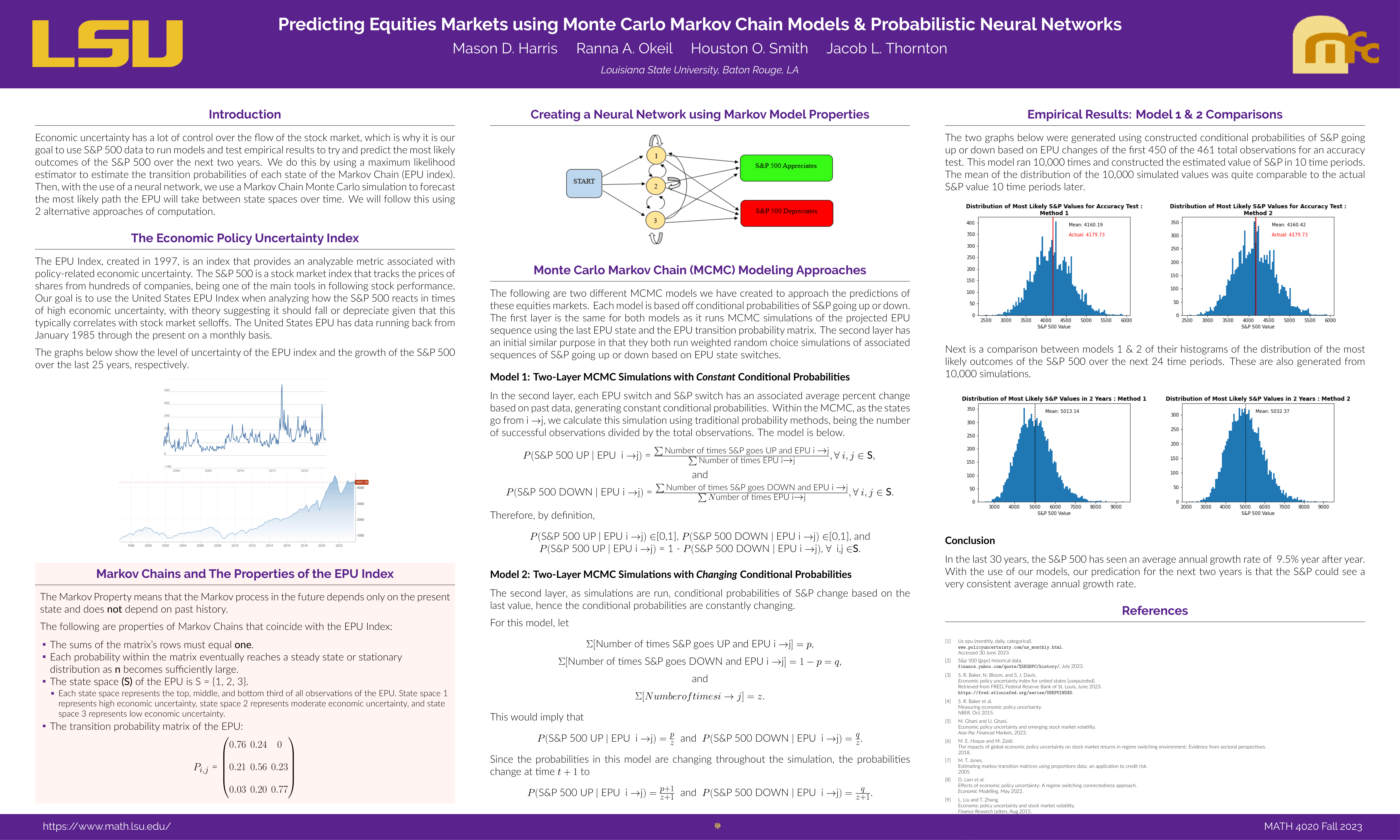
The Equity Market Prediction Project focuses on using Markov Chain Monte Carlo (MCMC) models and probabilistic methods to investigate possible future movements of the S&P 500. The project uses the Economic Policy Uncertainty (EPU) Index to represent different levels of economic uncertainty and studies how changes between these states are associated with movements in the S&P 500. Two MCMC approaches were developed using constant and changing conditional probabilities, with simulations used to estimate possible future market outcomes. The models were tested using 10,000 simulations and produced estimated S&P 500 values that were comparable to the observed values in the project's accuracy test.
| Attachment | Size |
|---|---|
 Slides Slides | 1.23 MB |
| Poster | 522.48 KB |
| MATH_4020_Pennington.pdf | 699.43 KB |
| DeVision_Fall2023_poster.pdf | 3.3 MB |
| markov_chain_poster.pdf | 829.2 KB |
 DeVision_Fall2023_poster-1.png DeVision_Fall2023_poster-1.png | 2.45 MB |
| Markov_chain_poster-1.png | 1.18 MB |
| MATH_4020_Pennington-1.png | 1.09 MB |